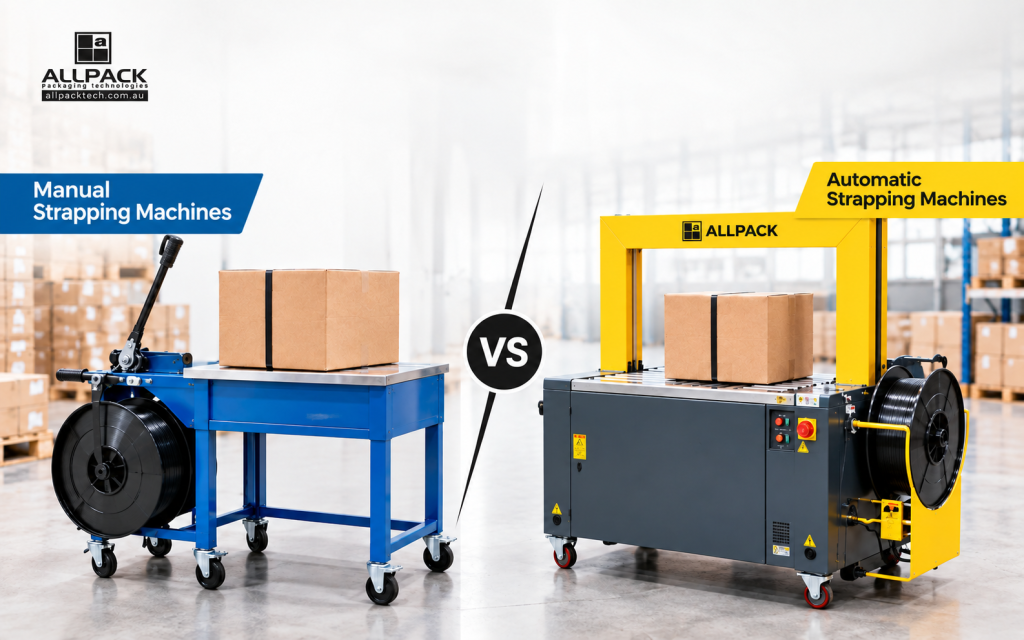
Manual vs Automatic Strapping Machines: What’s Best for Your Business?
If you choose the wrong strapping machine, it will cost more than money. It costs time on the packing line, consistency in your loads, and sometimes a customer who receives a damaged pallet.
Every business shipping boxes or palletised goods eventually asks the same question: stick with hand tools, or automate?
The honest answer depends on daily volume, product mix and budget, not on which option sounds more impressive.
In this guide, we are going to break down manual, semi-automatic and automatic strapping machines with real benchmarks, so you can match the right equipment to your operation.
Manual Strapping Machines
A manual strapping machine puts the operator in full control of every strap. You loop the strap around the load by hand, tension it with a hand-held tensioner, seal it with a buckle or heat-seal tool, then cut it. Options range from basic combination tools to battery-powered handheld units.
The appeal is straightforward. Manual strapping tools cost far less upfront than any machine, which matters for a growing business watching capital spend closely.
They’re also light, portable, and need no fixed power source, so an operator can carry one between packing stations or straight onto a truck.
Flexibility is the other win. A hand tool doesn’t care if today’s load is an odd-shaped crate and tomorrow’s a standard carton. No changeover, no programming, just strap, tension, seal.
Best Uses for Manual Strapping Machines
Manual tools suit low-volume or occasional strapping jobs where flexibility matters more than raw speed. As a rough benchmark, a standard hand tool manages around 20 pallets a day, while a battery-powered handheld tool can push closer to 100.
They’re a natural fit for small workshops, regional warehouses, timber and building supply yards, furniture makers, and e-commerce operations juggling mixed carton sizes. For fieldwork or remote sites without reliable power, a manual tool is often the only practical choice.
Automatic Strapping Machines
An automatic strapping machine feeds, tensions, seals and cuts the strap with almost no manual input. You place the carton on the table or conveyor, a photocell or sensor detects it, and the machine runs the full cycle in seconds.
Speed is the standout benefit here. Cabinet-style automatic machines typically run at 29 to 60 straps per minute, and tandem or twin-head systems can process up to 32 bundles per minute on continuous lines.
That consistency matters just as much as the speed. Every strap gets the same tension and the same seal quality, so you stop relying on how tired or careful an operator is at 3 pm on a Friday.
This is also where industrial strapping equipment earns its keep on worker safety. Repetitive tensioning and bending over cartons all shift is classic hazardous manual task territory, and it’s a recognised contributor to musculoskeletal injuries under Safe Work Australia’s manual handling guidance. Automating the strap cycle takes that physical load off staff and lets them supervise instead. Most automatic units also integrate directly with existing conveyors, carton sealers and palletising lines for one continuous flow.
Best Uses for Automatic Strapping Machines
Automatic strapping earns its keep in high-volume operations processing hundreds or thousands of packages a shift. That includes distribution centres, food and beverage plants, pharmaceutical packing lines, printing and paper mills, and busy e-commerce fulfilment sites. It performs best where carton sizes are standardised, and runs are continuous, since that’s where the speed advantage really compounds.
Manual vs Automatic Strapping Machines: A Detailed Comparison
Here’s the side-by-side that most buyers actually want to see.
| Operational Feature | Manual Tools | Automatic Strapping Machines |
| Packaging speed | ~20–100 pallets/day, several minutes per strap | Up to 29–60 straps per minute, continuous |
| Labour required | High; full manual positioning and tensioning | Minimal; supervised, automated cycle |
| Tension and seal quality | Varies with operator skill | Consistent, preset digital tension |
| Load flexibility | Excellent with irregular shapes | Best with standardised cartons |
| Upfront cost | Lowest | Higher initial investment |
| Cost per strap long-term | Higher, due to labour and rework | Lower at scale |
| Power needs | None, or small battery | Dedicated power supply, typically 240V |
Neither column is objectively “better.” A ten-person workshop strapping timber packs doesn’t need a 60-strap-a-minute machine, and a distribution centre shipping thousands of cartons a day can’t run on hand tools without bottlenecking every shift.
How to Choose the Right Strapping Machine for Your Business
Consider Your Packaging Volume
Daily volume is the single biggest decision driver. A few dozen packages a day sits comfortably with manual or battery tools. Moderate daily volumes usually justify a semi-automatic tabletop unit. Once you’re shifting hundreds or thousands of items a shift, a fully automatic machine is what keeps dispatch on schedule.
Match the Machine to Your Products
Not every plastic strapping machine handles every strap type the same way. Polypropylene (PP) strap is light and economical, well suited to box strapping across manual, semi-automatic or automatic setups.
Polyester (PET) strap holds far more tension over time and is the better call for heavy pallet loads and rigid freight, as most strapping suppliers note when comparing PP and PET performance. For steel or timber, you’ll need heavy-duty steel strap and matching tools. Bundling fragile cartons calls for a machine with a squaring mechanism to stop crush damage.
Factor in Labour and Packing Speed
Look honestly at how many staff are tied up strapping right now, and whether that’s creating a bottleneck further down the line. If one or two operators are strapping full-time and the packing line still backs up, automation frees them for other tasks and lifts overall throughput. It also cuts the physical strain that leads to injury claims.
Check Your Space and Power Requirements
Manual tools need almost no floor space and no wiring. Automatic strapping equipment is a different story, ranging from compact tabletop units to full arch machines and inline conveyor systems.
Before you commit, check your floor space, bench heights, and whether you’ve got a 240V single-phase supply where the machine needs to sit.
Compare Upfront Cost With Long-Term Value
The purchase price only tells half the story. Manual tools are cheap to buy but expensive to run at volume once you factor in labour hours and the occasional loose or rejected load.
Automatic machines cost more upfront but pay that back through labour savings, faster dispatch and fewer damaged shipments once volume justifies it.
Is a Semi-Automatic Strapping Machine the Better Middle Ground?
For a lot of growing businesses, yes. A semi-automatic strapping machine sits between hand tools and full automation: the operator positions the box and feeds the strap into the machine, and it takes over from there, tensioning, heat-sealing and cutting in a few seconds. Most semi-automatic tabletop units run at around 20 straps per minute.
The appeal comes down to three things:
- Lower cost than a fully automatic arch machine, while being noticeably faster than manual tools
- Easy to operate, with minimal training needed for warehouse staff
- Flexible across varying box sizes and strap widths without major setup changes
It’s often the natural next step once manual strapping starts limiting output, and one of the more practical strapping solutions for warehouses handling mixed pallet and carton runs.
When Should You Upgrade From Manual to Automatic Strapping?
A few signals tend to show up together when it’s time to move on from hand tools:
- Order volumes are climbing, and manual strapping is now the bottleneck holding up dispatch
- Labour costs are creeping up, with overtime becoming the norm during peak periods
- Load stability is inconsistent, leading to loose straps, collapsed packages, or rejected shipments
- Injury risk is rising from repetitive manual tensioning across a shift
- Upstream automation has outpaced strapping, so carton erectors or sealers are now faster than your packing team can strap
If two or three of these sound familiar, it’s worth getting a proper volume and product assessment done before you buy anything.
Get the Right Strapping Machine With Allpack Packaging Technologies
At Allpack Packaging Technologies, we have been supplying packaging machinery to Australian businesses since 2000, and strapping equipment is one of the areas we know best.
Our PACKWAY strapping machine range, including the semi-automatic PW-316H, covers everything from mechanical tensioning tabletop units through to fully automated systems for continuous lines, and we can look at custom automation for businesses with non-standard load requirements. If you’re still weighing up strapping against other joining methods, our guide on banding vs strapping machines is worth a read first.
Based in Osborne Park, WA, we supply and support customers Australia-wide, with installation, servicing and spare parts backed by a local team who actually understand the equipment.
If you’d like more detail on the decision factors before you commit, our full buying guide for strapping equipment covers the ground this article doesn’t.
FAQs
Can I use both PP and PET strap on the same strapping machine?
Only if the machine is rated for both. Tension settings and strap guides differ between PP and PET, so check compatibility with your supplier before switching strap types.
How long does an automatic strapping machine last?
With regular servicing, most industrial strapping machines run reliably for 8 to 15 years. Duty cycle, strap quality and maintenance schedule all affect actual lifespan.
Can a strapping machine damage boxes or products?
Yes, if tension is set too high or the strap position is wrong. Automatic machines with digital tension control and squaring guides reduce this risk compared to manual tensioning.
Do I need a licence or training to operate a strapping machine in Australia?
No formal licence is required, but operators should receive supplier-provided training on safe tensioning, sealing and machine lockout procedures before use.
Is it cheaper to lease or buy a strapping machine?
Buying suits businesses with steady, ongoing volume, since it avoids long-term lease costs. Leasing can help if volume is seasonal or you’re trialling automation before committing capital.