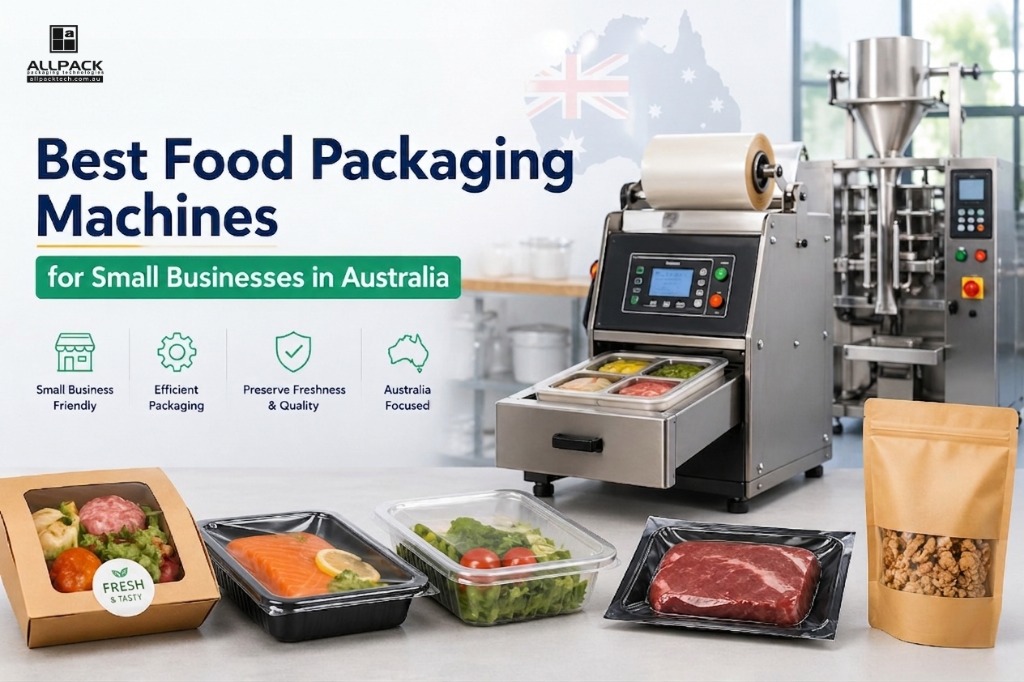
Food packaging is not limited to only sealing a product. Because you have to maintain freshness, ensure food safety, and professionally present your product.You have to further keep in mind your budget, production volume, and space constraints while choosing the right food packaging machine for your business.
At Allpack Packaging Technologies, we have efficient and scalable food packaging machines that we designed specifically for small to medium-sized operations.
In this guide, we’ll explain the best food packaging machines that you can adopt for businesses, grouped by use case, so by the end, you will be able to choose a machine that is best for your products.
Our experts suggest that these key factors should be clear in our minds before we start looking at different machines.
Before a purchase, focus on those machines that deliver value without expensive upfront investment. For example, manual and semi-automatic machines are the best starting point.
Pick a machine as per the level of automation you need for your business. Otherwise, you will spend more bucks on a machine that is useless to you.
Analyse your packaging needs and then decide on the machine accordingly. Have a look at the example below:
Another factor that you must keep in mind before making a purchase is the packaging material you are going to use. Because machines vary depending on whether you use:
You have to think ahead, like ask yourself, how many units per hour or day do you need? A machine that works today should still support your business in 6–12 months.
Now is the time to look at the machines. Below, we have listed some of the best packaging machines and categorised them for different businesses. So have a look:
The majority of fresh food products are packaged using tray sealing machines. These machines seal film onto preformed trays. In addition, these machines allow the use of MAP (Modified Atmosphere Packaging), so the products remain fresh for a long period of time.
They are widely used by:
If you want to start tray sealing without jumping straight into a larger automated system, MSTS can be a great entry-level option. It suits fresh-counter packaging and offers sealing area options of 10″ x 12″ and 14″ x 18″.
MAP capability is available if needed, and it seals clear or random printed film onto preformed trays before neatly trimming the finished pack.
It offers a low-cost entry into tray sealing. Without compromising packaging quality.
This is a strong step up if you need more output but still want to keep the process manual and controlled. Unlike shuttle machines, this uses a two-station rotary system, allowing one tray to be sealed while another is being prepared. This significantly improves efficiency. Furthermore, it uses a standard 14″ x 18″ sealing area.
Growing food businesses that need faster throughput but still want control over operations.
It works as a middle option between manual (by hand) and fully automatic packaging. So you will not go fully automatic or fully manual.
For businesses ready to scale, this continuous conveyor system is built for higher-output tray packaging.
The AITS-1216 and AITS-1220 offer sealing areas of 12″ x 16″ and 12″ x 20″, with options designed to increase productivity.
The AITS series is our fully automatic, inline system with a conveyor, designed for continuous production. Moreover, it supports MAP and skin packaging and is built for consistent, high-output environments.
If you are a small business and are planning a transition into medium-scale production or supplying retailers.
Its speed and consistency make it special. As it will eventually reduce your labour dependency.
This rotary machine is designed for businesses that need automation in a more compact format, like more space-efficient compared to inline systems and uses a standard 10″ x 15″ sealing area.
Furthermore, it’s designed for fresh food packaging and supports MAP. So it is ideal, if you care about shelf life and presentation of your products.
Businesses that need automation but have limited floor space.
It combines efficiency with a compact footprint.
Many companies in Australia now place strong importance on sustainability. So, this machine is worth considering if your brand is adopting more sustainable packaging practices. These semi and fully automatic board-to-tray machines heat-seal paperboard lids to plastic and paperboard trays.
They are six-station rotary machines with a standard 15″ x 20″ sealing area, and the RBFA model includes a lid feeder and finished package unloader for added automation.
Brands focused on sustainable packaging or environmentally friendly consumers.
This machine aligns with the current market demand for environmentally friendly packaging.
This continuous band sealer of ours is a strong fit for businesses packaging plastic bags and pouches in medium volumes.
Despite having a stainless steel finish, it is compatible with food and medical hygiene requirements.
Moreover, it is a versatile choice for dry-food packaging, as it works with materials such as polyethylene, polylaminates, co-extrusions, and shrink films.
Businesses that package dry food products in medium volumes.
It increases efficiency while maintaining consistent seal quality.
If your business deals with bulk dry ingredients, standard sealing machines won’t be enough. So look at the following option.
This portable single-thread bag sewing machine is a practical choice for closing paper or woven bags in bulk ingredient workflows. Furthermore, it’s portable and widely used in industries that handle flour, grains, and other bulk food products.
It works with materials like:
Small producers, wholesalers, or businesses handling bulk packaging.
One of its main features is portability. So, it is ideal for flexible work environments.
Packaging isn’t just about sealing; it’s also about getting the right quantity into each pack. So have a look at our Magnum weighing and filling machine:
This electronic small net-weigh scale is built for granular products and is designed for weighments from 2 oz. to 12 lb. A Jumbo Version is also available that can handle up to 25 lbs.
It uses a solid-mount net-weigh bucket for better accuracy and is made to meter product into bags, pouches, or pails.
With the help of this machine, you will accurately measure and dispense materials into:
Businesses selling dry goods. For example, spices, grains, or powders.
This machine improves consistency and reduces waste. So eventually speeds up your packaging process.
Here’s a quick breakdown based on business type:
At Allpack Packaging Technologies, we’ve helped businesses in Perth to choose the right packaging machines for over 25 years now. We work with Top manufacturers to supply equipment that will improve day-to-day efficiency. of your business.
Furthermore, we can also create a tailored system if your workflow has special requirements.
Do small businesses need automatic machines?
Not always. You can start with manual or semi-automatic machines and later upgrade them.
What is MAP packaging?
Modified atmosphere packaging is basically a technique to preserve food. It replaces air inside the package with gases like carbon dioxide, nitrogen, and oxygen to extend shelf life.
Can one machine handle all food types?
No, you will need different packaging machines for different products. For example, tray sealers for food items and capping machines for liquids.
When should I upgrade my machine?
When your current setup limits production speed or product quality, that is the right time to upgrade your packaging machine