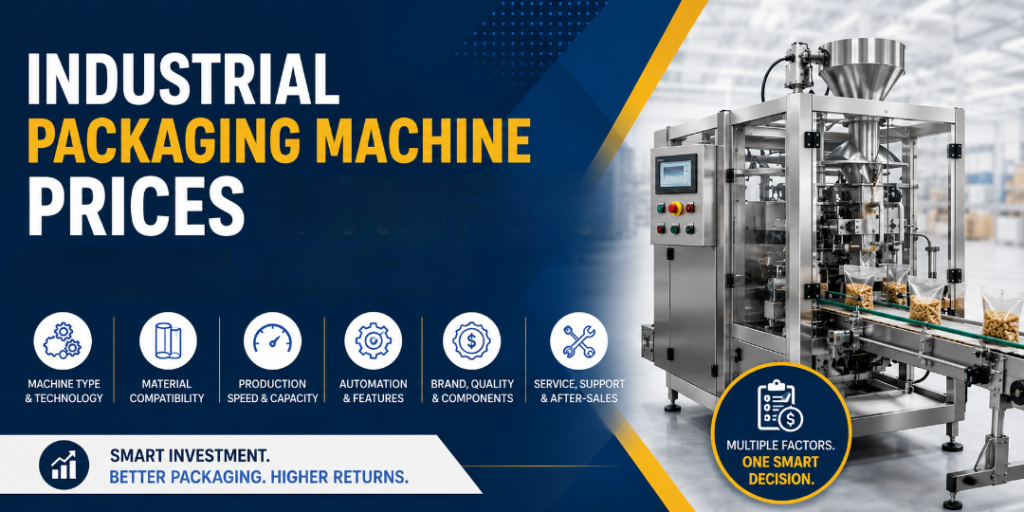
In Australia, the price of industrial packaging machines varies from less than $500 for basic sealing machines to more than $40,000 for high-end automated systems, with the average cost between $5,000 and $15,000, depending on the kind of machine and features.
This guide will show you the price ranges for industrial packaging machines and the main things that affect their cost. So let’s begin.
Packaging Machine Price Ranges in Australia (2026)
| Industrial Packaging Machines | Entry-Level Price (AUD) | Mid-Market Price (AUD) | High-End Price (AUD) | Common Buyers in Australia |
| Pallet Wrappers | $5,500 – $10,000 | $10,000 – $18,000 | $20,000 – $40,000+ | Warehouses, logistics, manufacturing |
| Carton Sealing Machines | $500 – $3,000 | $3,000 – $8,000 | $10,000 – $25,000+ | E-commerce, distribution centres |
| Strapping Machines | $1,200 – $2,500 | $2,500 – $6,500 | $6,500 – $15,000+ | Freight, warehousing, and manufacturing |
| Bag Sealing Machines (Heat Sealers) | $50 – $500 | $500 – $2,000 | $2,000 – $5,000+ | Food, medical, retail packaging |
| Portable Bag Sewing Machines | $900 – $1,300 | $1,300 – $2,000 | $2,000 – $5,000+ | Agriculture, grains, feed, and chemicals |
Prices are indicative estimates based on publicly accessible Australian market data and are subject to change based on machine parameters, amount of automation, brand, supplier quotes, freight, installation and current market conditions.
9 Key Factors that affect Industrial Packaging Machine Cost
The cost of an industrial packing machine is based on a mix of physical attributes, level of technology and operating efficiency. Here are the nine factors that influence the overall industrial packaging machine cost.
1. Level Of Automation
Automation is often the biggest cost increase. The pricing of a semi-automatic pallet wrapper or carton sealer is different from a completely automatic system since the automatic system needs more sensors, PLC controls, programming, wiring and safety systems.
We could say the more the machine does for you, the more it costs. Manual or semi-automatic, the initial spend is lower, but when you want the machine to connect, cut, seal, detect, adjust and monitor on its own, the price quickly increases.
2. Production Volume And Throughput
The cost of the packaging machine will depend directly on the volume of production. Higher-output machines must run quicker, longer and with heavier workloads without failing.
For example, a pallet wrapper for 10 to 20 pallets per day is a pretty simple machine. But if you wrap 100, 200 or even 500 pallets a day in your operation, the machine needs bigger motors, beefier components, better controls and a design that can handle continuous use. All these upgrades increase the purchasing price.
In short, increased throughput means more engineering, tougher parts, and better performance under persistent usage. This is why equipment designed for high-volume operations tends to have a higher initial cost but generally cheaper expenses per package in the long run.
3. Machine Capacity, Load Size, and Dimensions
A machine designed to handle taller pallets, heavier cartons or greater arch sizes needs a larger frame and more substantial mechanical construction. That adds material cost, engineering cost and manufacturing cost straight away. The pricing of pallet-wrapping models is frequently based on load height and load weight, with some machines built to handle loads up to 2,000 kg.
The same applies to carton sealers. A machine that operates with one size of carton is simpler and cheaper than a random-size sealer that automatically adapts to different box sizes as they come.
4. Build Quality And Robustness
A harder machine costs more since it is made from tougher parts. Heavy-duty frames, improved stability, stronger welds, and more robust construction all add to the price, but they are also what keep the machine alive in a hard-working warehouse or factory.
Here is where ‘inexpensive’ may get pricey. A cheap machine may save money on day one, but maintenance, breakdowns and downtime will soon eat into those savings. A well-built machine is generally one that continues to run when the task gets filthy.
5. Drive Systems And Core Components
What you see outside the machine is as important as what’s going on inside it. Servo systems, PLCs, sensors, motion control and industrial drives all enhance precision and repeatability, but they also increase the cost. Automation gear is more expensive to purchase and integrate at the high end.
But the better the basic components, the better the machine often works under duress. This is why a machine with more powerful internal systems can be more expensive than a basic device that seems similar at a glance. The price difference is mostly in the pieces that do the real work.
6. Specialised Technology And Features
Extra features add cost because they add hardware, software, setup time and testing. Power pre-stretch, load sensing, automatic height identification, memory settings and automatic cutting or sealing functions boost performance, but none are free. Power pre-stretch machines are commonly offered with film savings and cheaper wrapping costs, which demonstrates how much value is wrapped up in one feature alone.
A simple machine performs the job. A machine with features does the task better, faster and with less waste. So, a smart pre-stretch pallet wrapper or an auto-adjusting carton sealer for varied box sizes would normally be significantly higher in the market.
7. Packaging Type And Product Compatibility
The more product types a machine can handle, the more it costs. It’s simpler to build a machine that handles just one simple type of packaging than to engineer a system that has to perform on many cartons, films, bag materials, or load shapes.
For example, carton sealers are available in standard versions for uniform cartons and random-size models for varied cartons, and that versatility adds expense.
The same applies to pallet wrapping and sealing devices. If the machine has to deal with diverse heights, widths, or product shapes, the engineering becomes more complex. More compatibility equals more design work, more testing, and more dollars on the buying price.
8. Ease Of Use, Training, and Maintenance Requirements
The machine that is easy to install, train on and maintain costs extra since the provider has integrated support into the offer. Such support can include commissioning, training of operators, replacement parts, maintenance planning and after-sales support. Those things matter because a machine is only valuable if the team can actually run it properly.
Better-supported machines might also save you money in the long run. Less maintenance, easier troubleshooting and quicker access to service all contribute to less downtime. That’s why the least expensive computer isn’t usually the least expensive machine to own.
9. Budget And Total Cost Of Ownership
The total cost of ownership comprises purchase price, installation, training, energy, consumables, service and maintenance. It also accounts for the cost of downtime when a machine breaks down or can’t keep up with the queue.
That’s why a machine with a larger price up front can be the superior purchase. Less film, less effort, and less waste keep the queue moving. It can pay for itself faster than a cheaper machine that burns time and consumables.
Find the Perfect Packaging Machine at Allpack Packaging Technologies
At Allpack Packaging Technologies, we supply pallet wrappers, strapping equipment, carton sealing, bag sealing and sewing solutions across Australia.
We are based in Perth and have been supporting businesses since 2000. So you will get equipment that balances upfront cost, performance and long-term value.
Furthermore, we also provide custom-built packaging solutions to suit your workflow.