In a warehouse or production line, wrapping pallets is more important than anything else.
Use too little film, and your loads can shift, collapse or sustain damage. Use too much, and material costs exceed the budget. Not to mention extra labour to change rolls. So, what do you need for efficiency? The quality stretch film and knowledge to use it properly.
Lucky for you, Allpack Packaging Technologies is going to provide you both. Because we’ve seen what the right stretch film roll mean for the safety of your products. And how it can change the reputation of your business.
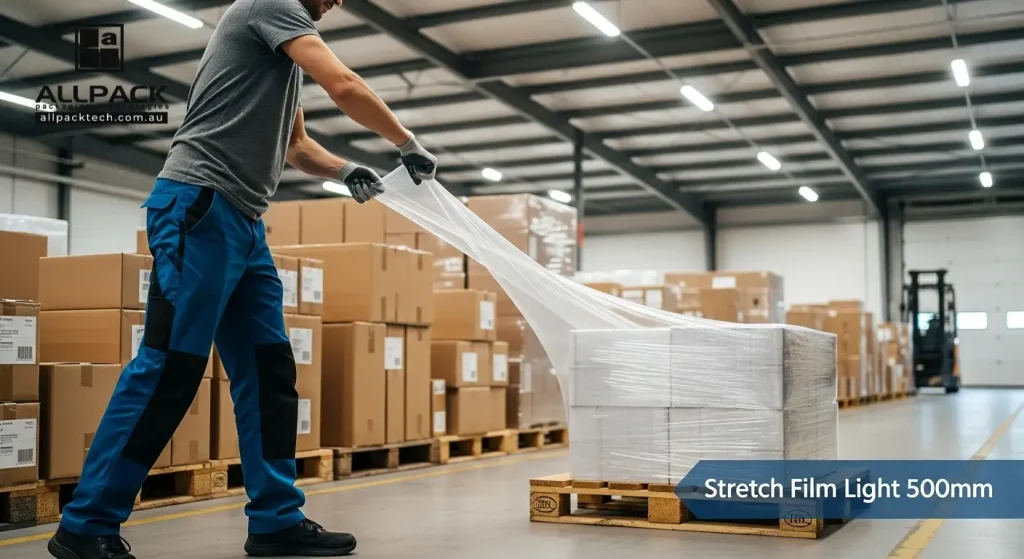
Most customers prefer our stretch film light 500mm as it gives a secure packaging without adding to the weight. We’ll also discuss its features in detail to see if it suits your packaging needs. Plus, some practical tips for usage are also in this guide.
So, without wasting a minute, let’s get started.
What Is Stretch Film?
Stretch film. also called stretch wrap or pallet wrap, is a plastic film made from linear low-density polyethylene (LLDPE). It’s designed to stretch when applied and then contract (or “recover”) to hold items tightly together.
This elasticity creates a strong tension to keep boxes, cartons, and other cargo bound to a pallet during transport or storage. Unlike shrink wrap, it doesn’t require heat and is self-adhesive. Means it clings to itself and form a stabilising “cage.”
Because of how it works, stretch film provides protection against dust and moisture, and also prevent load shifting. That’s why, it is a popular choice for distribution, manufacturing and logistics. Let’s discuss some important types used by various businesses.
Also Read: Why Stretch Films Beat Other Packaging Methods?
Types of Stretch Film Rolls
There are several types of stretch film, each suited to different use cases. We’ll go through them one by one to see which one is right for you.
1. Cast Stretch Film
It is made by cast extrusion, where molten resin is extruded through a die and cooled on chilled rollers. Transparency is very clear, with low noise when unwinding and good cling on both sides. You can use it in hand wrap applications because it stretches easily and is more economical. It is faster and less expensive than other types.
2. Blown Stretch Film
It is manufactured via blown extrusion. Means resin is extruded into a bubble, then cooled. Stretch film blown is more durable with higher puncture and tear resistance, and better load memory (it holds tension over time). You can use it for pallets with sharp edges, uneven loads, rough handling or difficult transport.
Types of Palette Wrap and Stretch Film by Usage
If we see usage, there are following types of stretch films in Aussie industries.
1. Hand Stretch Film
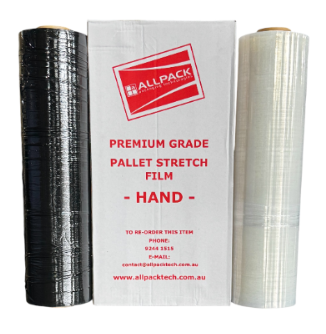
Hand pallet wrap is designed for manual application using a hand dispenser.
Features:
- Lightweight and easy to handle.
- Best for low-volume or irregular wrapping tasks.
- Available in different thicknesses for varying strength requirements.
- Reduces material waste by allowing controlled application.
How to Use:
- Place the film roll onto a stretch wrap dispenser.
- Start wrapping from the bottom of the pallet, maintaining proper tension.
- Overlap layers slightly for full coverage.
- Finish by securing the film end onto the wrapped load.
It is commonly used in smaller warehouses, retail stores, and operations where packaging needs are not high-volume.
2. Machine Stretch Film

Machine stretch film is used with automatic or semi-automatic wrapping machines.
Features:
- Provides uniform load containment with less effort.
- Increases wrapping speed and reduces labour cost.
- Available in different stretch levels to suit various load weights.
- Reduces the amount of film used, leading to cost savings.
How to Use:
- Load the film roll onto the wrapping machine.
- Place the pallet in the wrapping zone.
- Set the machine parameters based on the load size and film tension required.
- Start the machine and let it wrap the pallet automatically.
It suits high-volume packaging operations for continuous and efficient pallet wrapping.
Applications of Stretch Film & Pallet Wraps Across Industries
Light 500 mm stretch film finds use in many settings:
- Warehousing & Logistics: Secure pallets of boxes, cartons, or retail items.
- E-commerce / Distribution: Stabilise shipments in a cost-efficient way.
- Manufacturing: Wrap finished products or raw materials that don’t have sharp edges.
- Retail Back-of-Store: Wrap display pallets or hold inventory together.
- Food & Beverage (Non-Food-Contact): Useful in storage or transport where film contact isn’t direct.
Because light film is thin and clear, it supports barcode scanning and makes inventory management simpler.
Key Features of a Light 500 mm Stretch Film Roll
Feature | Description |
Width (500 mm) | This is a standard width compatible with most hand dispensers and wrapping machines. |
Light Gauge / Low Micron | “Light” refers to a thinner film. So, it is in the range of 12 to 20µm or similar, depending on the specification. |
Clarity | Cast light films are very clear, so, it is easy to see product labels or barcodes through the wrap. |
Elastic Recovery / Tension | Because the film stretches and “remembers” its shape, it holds items tight and secure. |
Self Cling | The film adheres to itself, and no tape is needed, means wrapping will be efficient. |
Roll Length | Depending on gauge, a 500 mm roll is long enough, so, you don’t need to swap rolls again and again. |
Now let’s find out the benefits you can enjoy with it.
Advantages of Using Stretch Film Light 500 mm
Choosing a light 500 mm stretch film roll offers several tangible benefits:
- Cost-Effective: Less plastic per pallet means lower material spend.
- Reduced Waste: Lighter gauge helps cut down on landfill or recycling weight.
- Fast Application: Self-cling and the right width make wrapping quicker.
- Good Load Stability: Elastic recovery keeps loads tight and stable.
- Visibility: Clear film enables scanning and visual checks of pallet contents.
- Longer Roll Life: Depending on length, fewer roll changes mean less downtime.
In short, it streamlines your operations and increases the productivity.
Thickness (Gauge) of Stretch Film & its Effect on Performance
Thickness (or gauge) is usually expressed in microns (µm), and affects both cost and performance. E.g.
Gauge / Thickness | Use | Benefits |
~12–17 µm | Light, stable loads | Very economical, high yield, but less puncture resistance. |
~18–23 µm | Medium-weight pallets, general warehouse loads | Balanced strength and cost, good for many distribution needs. |
24 µm+ | Heavy or irregular loads, sharp edges | Excellent tear and puncture resistance, but uses more plastic. |
For example, experts suggest a film in the 15–18 µm range (about 60–70 gauge) for loads up to around 360 kg. But heavier pallets require thicker film of 20–30 µm. If you down-gauge (use a thinner film) to save cost, you have to apply more layers and material will be wasted.
How Light 500 mm Stretch Film Works? Real-World Use Case
Imagine a Perth-based food packing facility using a 500 mm light-gauge cast stretch film. Their pallet loads consist of boxed, uniform snack packs. These loads don’t need very high puncture resistance, but they should be tightly held together to ship and store.
By switching to a light 500 mm film, the facility reduces its film costs, lowers the frequency of roll changes, and speeds up its hand-wrapping process. Because the film is clear, the team can still scan barcodes through the wrap without cutting it open.
The net effect: better efficiency, lower expense, and reliable pallet stability.
Choosing the Right Stretch Film for Your Business
Selecting the right pallet stretch wrap depends on several factors. Keep the following things in mind while choosing a certain type.
1.Type of Product
Products are the first deciding factor in almost all packaging decisions.
- Fragile items need softer, more flexible wrapping to avoid damage.
- Sharp items require stronger, thicker film for better stability.
So, assess your products before choosing a wrap film.
2. Weight of Product
It also depends on your type of product.
- Lightweight products can be wrapped with standard stretch film.
- Heavy pallets need a thicker and high-strength film to prevent tearing.
Discuss your weight requirements with the stretch film retailer before-hand.
3. Value of Product
High-value items need an opaque stretch film to conceal contents and prevent theft. While visually appealing products need clear machine stretch film for easy identification. Decide what will work best for your business and marketing needs.
4. Mode of Transport
Type of transport will affect both plastic products & pallet wrap. E.g.
- Road transport requires strong film to withstand vibrations.
- Air freight needs lightweight film to reduce shipping costs.
- Sea freight involves moisture-resistant films.
Keep your business routes and transport in mind while packaging.
5. Distance to Destination
Distance and time required to reach the customers are also important factors. Longer distances mean more handling. So, it will require a stronger stretch wrap for protection.
6. Speed of Production
Do you have a small setup or high production business? How many pallets you need to rap per day? They are the deciding factors for type of stretch films. E.g. fast-moving production lines need machine stretch films to keep up with demand.
7. Use of Machines
Method of application also decides the type of stretch film. If your business involves automated packaging machines, make sure the stretch wrap is compatible with them.
Practical Tips for Applying Stretch Film
Follow these practices for applying stretch film to get maximum effectiveness.
- Use a 3-1-3-1 wrapping pattern. Wrap around the base 3 times in a spiral up, then 3 times at the top, and back down once. It builds good containment force.
- Maintain consistent tension in wrapping to avoid film breaks or weak spots.
- Overlap layers by 50% when spinning around the pallet for stability.
- Avoid over-stretching when wrapping by hand. Too much stretch can weaken the film and increase the risk of breakage.
- Secure the film’s tail properly, and make sure corners are wrapped carefully because sharp edges can puncture.
Need High-Quality Palette Wrap and Stretch Film?
Buy Stretch Wrap Australia at Allpack Packaging Technologies
Based in Perth and serving all of Australia, we offer a broad range of stretch films, from light 500 mm rolls to heavy-duty blown film. Plus, our expert can help you select the right solution for your business. We’ve been doing this since 2000, so we know what it takes to build wrap strategies that save you money and time.
Give Us a Call on 08 9244 1515