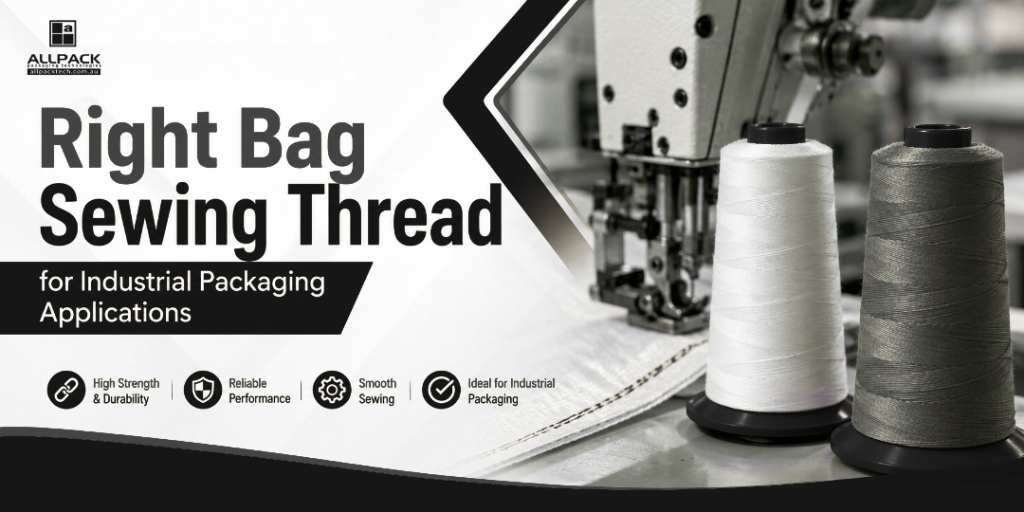
Choosing the right bag sewing thread is a specification decision, not a stationery decision. Get it wrong and you get seam failure on the production line, product loss in transit, and warranty claims from customers whose bags split open in the warehouse. Get it right and your bag closing machine runs faster, with fewer breakages and a cleaner finish.
This guide sets out exactly how to match thread to bag material, contents and closing machine, based on the properties that actually govern sewability and seam life: material, decitex, ply, twist, lubrication and certification.
What Is Bag Sewing Thread?
Bag sewing thread is a specialised industrial thread used to close woven and non-woven bags on a bag-closing (bag-sewing) machine, rather than a heat sealer or adhesive system. Unlike garment thread, it’s engineered for high-speed chain-stitch machines, continuous cone or cylinder feed, and repeated contact with abrasive materials such as woven polypropylene, kraft paper and burlap.
To choose the right bag sewing thread, match the thread material and tensile strength to your bag material and product contents, then confirm it’s compatible with your closing machine’s tension and feed system.
Why Choosing the Right Thread Matters
Every bag seam carries the full weight of the product inside it, and that load is concentrated along a single stitch line. A thread that’s too weak, too coarse, or poorly lubricated causes three recurring problems on packaging lines:
- Seam failure in transit: bags split at the closure, not the fabric, because the thread (not the bag material) was the weak point.
- Machine downtime: inconsistent thread diameter or knots snap in the tension discs and needle guides, stopping production.
- Compliance risk: food, pharmaceutical and agricultural products may require certified, food-safe thread and lubricants.
Thread is a small line item on a purchase order but a major variable in seam reliability, so it deserves the same scrutiny as the bag film or machine itself.
Types of Bag Sewing Thread
Polyester Thread
The industry standard for industrial bagging. High tensile strength, low stretch, and strong resistance to moisture, mildew and UV degradation. Common for woven polypropylene bags in agriculture, building products, chemicals and animal feed.
Nylon Thread
The strongest common option, with higher elasticity than polyester. Suited to heavy-duty bags that flex or take impact in transport, though it absorbs more moisture and can shrink slightly in humid conditions.
Polypropylene Thread
Lightweight and chemically resistant, making it practical for fertiliser, powder and mineral bags where chemical exposure would degrade other fibres.
Cotton Thread
Softer, biodegradable, and lower in strength and moisture resistance than synthetics. Mostly used for lighter-duty or compostable packaging, such as some food or retail bags.
Polyester vs Nylon vs Cotton vs Polypropylene
| Material | Strength | Moisture Resistance | UV Resistance | Best Applications |
| Polyester | High | Very good | Very good | Woven PP bags, agriculture, general industrial |
| Nylon | Highest | Moderate | Good | Heavy-duty, high-impact or flexing loads |
| Polypropylene | Moderate | Excellent | Good | Chemicals, fertiliser, powders |
| Cotton | Low | Poor | Poor | Light-duty, food, compostable packaging |
Essential Thread Properties
Beyond raw strength, sewability and seam life depend on:
- Uniform diameter: prevents tension swings on spring-loaded discs, which cause skipped or broken stitches
- Surface lubricity: low friction lets thread pass smoothly through guides and the needle eye
- Suppleness: easier loop formation for consistent machine stitching
- Low elongation: tighter, more predictable stitch timing
- Balanced twist (torque-free): prevents kinking and tangling
- Low linting: less build-up in tension guides and bobbin case
- Heat resistance: withstands friction against the needle at high speed
- Free of knots and twist variation: fewer breaks, lower reject rates
Bag Material vs Recommended Thread
| Bag Type | Recommended Thread | Why |
| Woven polypropylene (PP) | 12/4 or 20/6 spun polyester | High tenacity, abrasion-resistant, cost-effective |
| Multi-wall paper | Polyester or polyester/cotton blend | Balances strength with gentler handling of paper |
| Burlap/jute | High-tenacity nylon or polyester | Withstands coarse, abrasive fibres |
| Chemical/fertiliser bags | Polypropylene thread | Chemical resistance protects seam integrity |
| Food-grade bags | Certified polyester with approved lubricant | Meets food-contact safety requirements |
How to Choose the Right Bag Sewing Thread
- Identify the bag material: woven PP, paper, burlap or film all wear thread differently.
- Consider the contents: chemicals, food, fertiliser or general goods each carry different resistance requirements.
- Check your closing machine: confirm the thread’s diameter and ply suit your machine’s tension discs and needle.
- Match tensile strength to load: heavier bags need higher DTEX or more plies.
- Confirm certification needs: food or pharmaceutical products may require FDA-compliant lubricant.
- Select colour for branding, batch identification, or visual quality control.
Thread Specification Guide
| Property | Why It Matters |
| Material | Determines strength, moisture and UV resistance |
| DTEX / thickness | Grams per 10,000m; lower DTEX = finer thread, higher = coarser |
| Plies & twist | More plies/twists increase strength but can stiffen the thread |
| Lubrication | Reduces friction and breakage; food use needs certified lubricant |
| Melting point | Higher melting point (polyester ~250–260°C) resists heat build-up at high sewing speeds better than cotton |
| Colourfastness | Prevents bleeding onto product or packaging |
Choosing Thread for Different Packaging Applications
- Agriculture and animal feed: UV-stabilised polyester for outdoor storage and transport.
- Chemicals and fertiliser: Polypropylene thread to resist corrosive dust and residues.
- Food processing: Certified polyester thread with compliant lubricant for contact safety.
- Building materials: High-tenacity polyester for abrasive, heavy contents like cement or aggregate.
- Retail and produce bags: Lighter cotton or polyester/cotton blends where appearance matters more than load.
Choosing Thread for a Bag Closing Machine
For most portable and industrial bag closing machines, 12/4 or 20/6 high-tenacity spun polyester is the standard recommendation.
It resists rotting, tearing and mildew, and handles woven polypropylene, multi-wall paper and burlap reliably at production speed.
Always check your specific machine’s needle size and tension range before switching thread specification, since mismatched thread diameter is one of the most common causes of unexplained stitch faults.
Common Mistakes When Choosing Bag Sewing Thread
- Choosing thread purely on price, ignoring DTEX and ply suitability
- Using non-certified thread for food or pharmaceutical contact applications
- Ignoring UV stability for bags stored or transported outdoors
- Mismatching thread diameter with machine tension settings
- Buying thread with visible knots or inconsistent twist, causing frequent breaks
- Overlooking lubrication, leading to higher friction and premature wear
Why Businesses Choose Allpack Packaging Technologies
Allpack Packaging Technologies has supplied packaging machinery and consumables across Australia since 2000, and supplies bag sewing thread engineered to run cleanly through bag closing machines with minimal breakage. The range includes:
- Portable Bag Sewing Thread: UV stabilised and palm oil lubricated, available in white, red, black and blue
- Industrial Bag Sewing Thread (2kg): UV stabilised and palm oil lubricated, available in white, red, black and beige
- Industrial Bag Sewing Thread (7kg): UV stabilised and palm oil lubricated, available in white and red
All three are UV stabilised, palm oil lubricated for smoother feed through tension guides, and available in additional colours to order. Combined with Allpack’s bag closing machine range and technical support, businesses can source machines and consumables from a single supplier.
Contact our team today or learn more About Allpack Packaging Technologies.
FAQs
How long does industrial bag sewing thread last?
Properly stored industrial polyester thread can remain usable for several years.
What causes thread breakage during bag sewing?
Incorrect tension, poor-quality thread, or machine incompatibility are the most common causes.
What are common bag sewing mistakes?
Using the wrong thread type, thickness, or machine settings are the most common mistakes.
Does thread thickness matter?
Yes, the correct thread thickness ensures strong seams and smooth machine performance.