
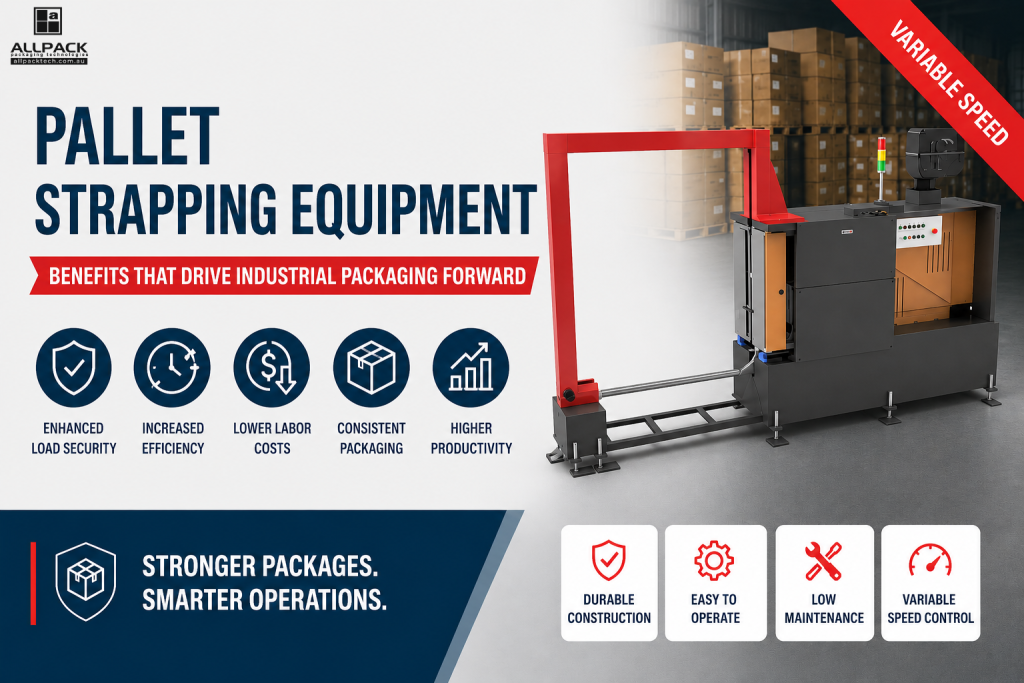
Modern pallet strapping equipment helps businesses secure palletised goods with greater speed, control and consistency. It can reduce repetitive manual work, apply more repeatable strap tension and help packing teams prepare loads more efficiently for storage, handling and dispatch.
The size of that improvement depends on the equipment you choose. Manual tools remain practical for occasional jobs, battery-powered tools suit mobile and repetitive work, and pallet strapping machines are designed for operations that need a more structured process.
What Is Pallet Strapping Equipment?
Pallet strapping equipment is used to tension and join straps around goods placed on a pallet. The straps hold individual cartons, bundles or materials together as a consolidated unit.
This process is known as unitising. According to the National Heavy Vehicle Regulator, unitising goods can support load stability, make handling easier and reduce the likelihood of individual items moving or becoming dislodged.
Pallet strapping equipment can include:
- Manual tensioners and joining tools
- Battery-powered strapping tools
- Sealless tools for steel strap
- Semi-automatic strapping machines
- Automatic pallet strapping machines
Each option changes how much of the process is completed by the operator.
Benefits of Modern Pallet Strapping Equipment
Here are some of the main benefits of modern pallet strapping equipment.
- Better Stability for Palletised Goods
- More Consistent Strap Tension
- Faster Strapping for Repetitive Work
- Less Physical Effort for Operators
- Equipment for Different Working Environments
- Compatibility with Different Pallet Straps
- Fewer Separate Steps with the Right Tool
- A Strapping Setup That Can Develop with the Business
- Access to Servicing and Spare Parts
1. Better Stability for Palletised Goods
Pallet straps hold individual items together so they can be handled as a single load. This is especially useful when there are a number of cartons, bags or individual products on a pallet that could move during handling.
Strapping does not correct poor pallet construction. Products still need to be stacked appropriately, and the selected strap must suit the weight and characteristics of the load. When those basics are addressed, pallet strapping provides another level of support around the finished pack.
For businesses regularly moving palletised goods between production, storage and dispatch areas, better unitisation can make each load easier to manage.
2. More Consistent Strap Tension
Applying the right amount of tension matters. A loose strap may provide insufficient support, while excessive tension could crush cartons or damage vulnerable edges.
Manual pallet strapping depends on the operator’s technique and the equipment being used. Powered and automatic systems provide greater control over the selected settings, helping teams reproduce an established result across similar loads.
Allpack’s strapping range includes the Packway PW-620H with electronic strap tension. It also includes variable-speed models such as the PW-616H and the PW-YAO pallet strapping machine. These controls are useful when a business repeatedly straps products with similar packaging requirements.
Settings should still be reviewed whenever the load, carton strength, or strap material changes.
3. Faster Strapping for Repetitive Work
Manual strapping consists of a number of individual steps. The operator must position the strap, tighten it, create the joint, and remove or cut any excess material.
Powered tools and strapping machines can complete some of these operations mechanically. This can shorten the process when the same task is repeated across many pallets.
The real benefit depends on the entire workflow. A fast strapper machine will not solve a delay caused by poor pallet positioning or restricted access around the load. Businesses should assess the time required from the moment a pallet enters the strapping area until it is ready to leave.
Where strapping itself is the bottleneck, suitable equipment can help pallets move through packing and dispatch with fewer delays.
4. Less Physical Effort for Operators
Repeated pulling, tightening, bending, and reaching can make manual pallet strapping physically demanding. Battery-powered and automatic equipment can reduce the amount of force required during parts of the process.
Safe Work Australia identifies repetitive movement, sustained force and awkward postures as factors associated with hazardous manual tasks. Its guidance recommends considering mechanical aids and changes to work design where risks need to be eliminated or minimised.
The whole task should be assessed. A powered tool may reduce manual tensioning while operators still need to feed straps beneath pallets or work at an unsuitable height. Equipment placement, tool weight and access around the pallet all affect the final working arrangement.
5. Equipment for Different Working Environments
Not every business straps pallets at a fixed packing station. Some operators move between several pallets, while others process similar loads at one point on a production or dispatch line.
Manual and battery-powered tools provide mobility. Allpack’s ITATOOLS ITA21, for example, is a battery-powered tool compatible with 16 mm and 19 mm PET or PP strap. It allows the tool to move to the load.
A dedicated pallet strapping machine suits a different type of operation. Allpack lists the Packway PW-YAO as a variable-speed pallet strapping machine. This type of equipment is more relevant when pallet strapping takes place regularly at a defined point in the workflow.
Having different equipment levels allows a business to choose a setup based on how the work is organised rather than volume alone.
6. Compatibility with Different Pallet Straps
Modern pallet strapping equipment can support polypropylene, polyester, or steel strapping, depending on the tool or machine. This gives businesses options for different packaging applications.
Allpack’s range includes:
- Manual tensioning and joining tools for 15 mm and 19 mm PP strap
- The battery-powered ITA21 for 16 mm and 19 mm PET or PP strap
- The sealless ITA30 for 13 mm, 16 mm and 19 mm steel strap
- Semi-automatic and automatic machines within its PP strapping range
Equipment compatibility must be checked carefully. A tool designed for PP strap should not be assumed suitable for PET or steel, even when the width appears similar.
Allpack also supplies steel, PP, and PET packaging consumables, allowing the equipment and pallet straps to be considered together.
7. Fewer Separate Steps with the Right Tool
Some strapping setups require separate tensioning and joining tools. Other equipment combines functions or removes a consumable from the process.
Allpack’s ITATOOLS ITA30, for instance, is a sealless tool for steel strap. It creates the joint without separate seals or crimps. This reduces the number of components needed for a compatible steel-strapping application.
Battery-powered equipment can also combine powered tensioning and joining within one portable tool. An automatic pallet strapping machine carries the process further by completing a machine-controlled cycle.
The benefit is not simply having more automation. It is reducing unnecessary steps within a task that operators perform repeatedly.
8. A Strapping Setup That Can Develop with the Business
A business does not always need its final level of automation from the beginning. Its equipment can change as production volume, load consistency, and workflow develop.
Manual pallet strapping may be sufficient when jobs are occasional, or loads vary considerably. A battery-powered tool can support higher repetition while preserving mobility. A dedicated pallet strapping machine becomes more relevant when similar loads pass through a regular packing point.
This progression allows businesses to respond to an actual operational need instead of purchasing a large system before the workflow justifies it.
The decision should consider the number of pallets handled, but volume is only one factor. Product dimensions, strap material, working space, and the level of variation between loads also matter.
9. Access to Servicing and Spare Parts
The performance of pallet strapping equipment depends on more than its condition on the day it is installed. Parts availability, maintenance and technical support affect how useful the equipment remains over time.
Allpack provides technical support, service and spares for packaging machinery. Our Services include assistance with equipment selection and operation, fault diagnosis, repairs, maintenance, rebuilds and compatible spare parts.
On-site technical support is available across Australia depending on customer requirements and service location.
Considering support before purchasing is particularly important when a strapping machine becomes part of a regular production or dispatch process.
Manual, Battery or Automatic Pallet Strapping?
The right level of equipment depends on where the task takes place and how often it is repeated.
| Equipment type | How it works | Suitable situation |
| Manual pallet strapping | The operator positions, tensions, and joins the strap using hand tools. | Occasional work, changing load locations or access to limited power |
| Battery-powered tool | The operator positions the strap and uses a powered portable tool for compatible strapping functions. | Repetitive work requiring mobility between pallets |
| Semi-automatic machine | The operator remains involved while the machine completes selected stages of the cycle. | Regular packing where some automation would improve the process |
| Automatic pallet strapping machine | The machine performs an automatic strapping cycle at a defined station. | Repeated pallet strapping within a structured production or dispatch flow |
The word “automatic” does not always mean that every part of pallet handling is automated. Businesses should confirm how the pallet reaches the machine, which steps require an operator, and whether any additional handling equipment is needed.
What Should You Consider Before Choosing Equipment?
Start by identifying the problem the equipment needs to solve. This may be inconsistent tension, slow manual work, excessive operator effort, or a delay at the end of the packing line.
Then consider:
1. Your Palletised Goods
Write out the dimensions, approximate weight, and construction of the loaded pallets. Note whether the products are uniform or change regularly.
2. Your Current Pallet Straps
Confirm the strap material, width, and thickness currently used. Any new tool or machine must be compatible with these specifications, or the consumable setup will also need to change.
3. Daily Workload
Count the pallets handled during an ordinary shift as well as during busy periods. This helps determine whether manual, battery-powered, or automatic equipment is worth considering.
4. Packing Location
Decide whether the tool needs to travel to different pallets or the loads can move through a fixed strapping station.
5. Operator Involvement
Look at every manual step, including feeding the strap, accessing the lower part of the pallet, creating the joint, and inspecting the completed load.
6. Service Requirements
Ask how the equipment is maintained, whether compatible spare parts are available, and what technical assistance can be provided at your location.
Does Pallet Strapping Replace Vehicle Load Restraint?
Pallet strapping does not replace the restraint needed to secure a pallet to a vehicle. Strapping helps hold the goods together, while the complete pallet may still require a separate vehicle load restraint system.
The National Heavy Vehicle Regulator also advises that unitising alone may not restrain every item within a pack, particularly when low-friction products can still shift. The packaging and transport restraint arrangements should therefore be assessed separately.
Find the Right Pallet Strapping Equipment at Allpack
Allpack Packaging Technologies supplies manual tools, battery-powered equipment, semi-automatic machines, automatic strapping machines and compatible consumables.
Our range includes:
- Manual PP strap tensioners and joining tools
- ITATOOLS ITA21 battery-powered PET/PP strapping tool
- ITATOOLS ITA30 sealless steel strapping tool
- Packway semi-automatic and automatic PP strapping machines
- Packway PW-YAO variable-speed pallet strapping machine
- Steel, PP and PET pallet straps
- Technical support, servicing and spare parts
Tell us what you pack, which straps you currently use, and where the present process needs improvement. Our team can discuss the available equipment and help you compare suitable options.
View our strapping equipment or contact Allpack on 08 9244 1515.
FAQs
What are the main benefits of pallet strapping equipment?
Pallet strapping equipment can help to improve load unitization, make strap tension more repeatable, reduce manual tensioning work, and help businesses to complete repetitive strapping tasks more efficiently.
Which pallet strapping machine should I choose?
The right machine depends on the loaded pallet dimensions, product type, strap material, workload and packing layout. A portable tool may suit changing work areas, while a dedicated machine may suit repeated strapping at a fixed station.
Can the same machine use PP, PET and steel pallet straps?
Not necessarily. Every machine or tool has its own material and size specifications. Confirm the approved strap material, width, thickness and joining method before buying equipment or consumables.
What is the difference between manual and automatic pallet strapping?
The operator performs most or all of the steps in manual pallet strapping using hand tools. An automatic system completes a machine-controlled strapping cycle, although pallet positioning and other handling tasks may still require an operator or additional equipment.
Does Allpack supply handheld strapping tools?
Yes. Allpack supplies manual PP tensioning and joining tools, the battery-powered ITA21 for PET and PP strap, and the sealless ITA30 for steel strap.
Does Allpack service strapping machines?
Allpack provides technical support, repairs, compatible spare parts, maintenance, and rebuild services for packaging machinery. On-site support depends on the customer’s requirements and location.