
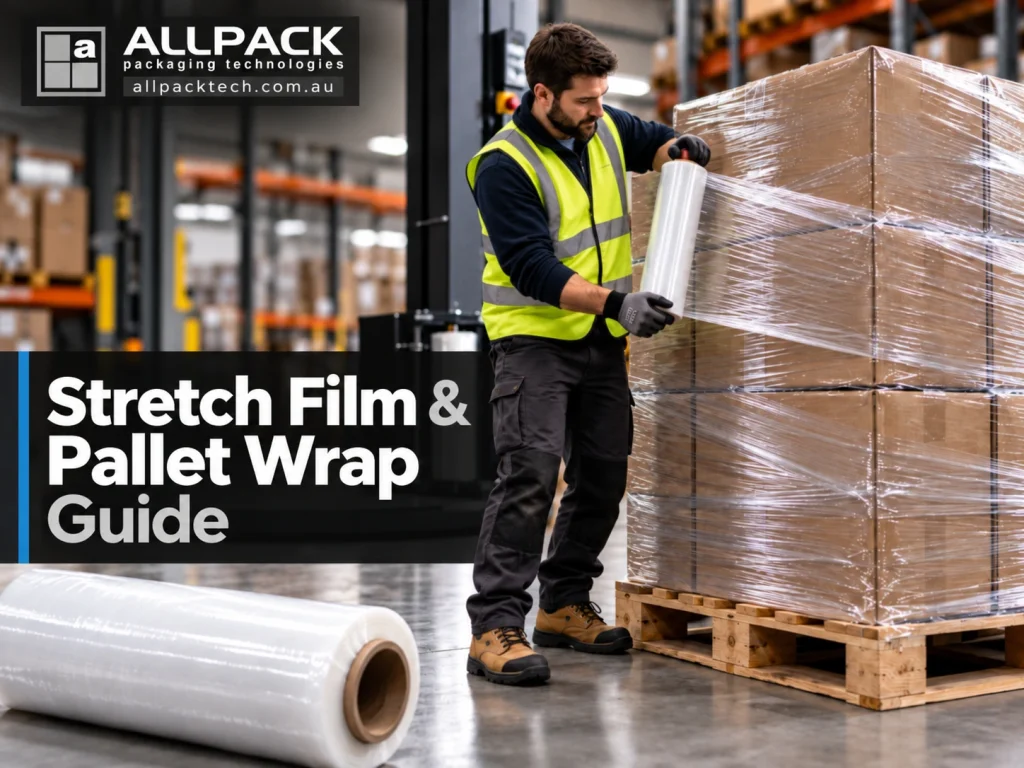
Picture a pallet that looks perfect in the warehouse. Then the truck takes its first corner, a carton shifts, and by the time it reaches the dock, the whole stack is leaning. Most of us have seen it happen, and it’s usually a wrapping problem.
That’s where stretch films and pallet wrap earn their keep. They’re cheap, quick to put on, and they pull a messy stack into one solid unit. So let’s talk about how they work, which type suits which job, and how to choose without overspending.
Disclaimer: This is general information only. The right wrap depends on your load weight, shape and how it’s moved, and product details can change. Check current specs and suitability with Allpack Packaging Technologies before you order, and always follow the film maker’s instructions.
What Is Stretch Film?
Stretch film is a thin, stretchy plastic, usually made from linear low-density polyethylene (LLDPE). As you wrap, you pull it tight, and it keeps trying to spring back to its original shape. That spring is what holds your load.
The National Heavy Vehicle Regulator describes it as film Stretch and Shrink Wrapping wrapped with tension around items to hold a load together on a pallet, applied by hand or by machine. You’ll also hear it called stretch wrap or pallet wrap. It’s all the same thing.
Which Type Do You Actually Need?
Start with how you wrap. If you wrap by hand, you want Hand Pallet Stretch Wrap. It’s a 500mm roll in 20, 23 and 25 micron, and it comes in clear or black. Clear is handy because your team can scan barcodes straight through the film. Black hides what’s inside. Allpack Packaging Technologies offers both in its pallet stretch film range.
Once you move to a pallet wrapper, you’ll switch to Machine Stretch Films. It’s the same idea on much longer rolls, often 1,300m to 1,600m on average, so nobody is stopping every few pallets to change a roll. Machine stretch wrap also comes in 20, 23 and 25 micron, in clear and black.
Then there’s Stretch Wrap & Bundle Film, a narrow roll that’s 100mm wide and 300m long. It’s 20 micron and clear, and it’s made for the small jobs, like holding lengths of timber, tubes or cartons together. It sits on a 76mm core, so it fits a standard hand dispenser. You’ll find it with Allpack’s other packaging consumables.
Last, there are pallet top covers. These are 1680mm x 1680mm sheets of 25 micron film in clear or black, supplied on a roll (around 250 sheets on average). They go over the top of a pallet and help keep dust and light rain off the goods.
Here’s the lot side by side:
|
Product |
Size |
Thickness |
Colour |
Best for |
|
Hand pallet stretch wrap |
500mm wide |
20, 23, 25 µm |
Clear, black |
Manual wrapping, low to medium volume |
|
Machine stretch film |
500mm wide, roughly 1,300m to 1,600m per roll* |
20, 23, 25 µm |
Clear, black |
Pallet wrappers, high volume |
|
Bundle film |
100mm x 300m, 76mm core |
20 µm |
Clear |
Bundling small items |
|
Pallet top covers |
1680mm x 1680mm, around 250 sheets per roll* |
25 µm |
Clear, black |
Covering the top of a pallet |
Roll lengths and sheet counts are average figures. Exact lengths vary with film thickness and batch, so confirm the current spec when you request a quote.
How to Choose Without Overthinking It
Think about the load first. Sharp or rigid edges can slice through film. The NHVR’s loading guide shows a pallet of bricks where the hard edges damaged the wrap and it pulled away from the load. If your goods have sharp corners, pad them before you wrap.
Next comes thickness, which is measured in microns. As a rough guide, thicker film is tougher, and thinner film stretches further. Lighter, tidy loads often do fine at the lower end, while heavy or lumpy loads may need more. If you’re not sure, test a few pallets before you order a big batch.
Then think about volume. A handful of pallets a day is easy by hand. Dozens a day is a different story.
Colour is the easy part. Go clear if you scan barcodes through the wrap, and black if you’d rather not show what’s inside.
When Does a Machine Make Sense?
Hand wrapping is fine when you’re starting out. But it’s physical. You walk circles around the pallet, bend down for the base and reach up for the top, again and again. Safe Work Australia’s Hazardous Manual Tasks Code of Practice hazardous manual tasks code of practice points out that lifting, pushing, pulling and carrying can be hazardous, and that businesses should assess the risks. Repeated hand wrapping is worth adding to that check.
If that sounds like your warehouse, a pallet wrapping machine takes the walking and bending off your team. Allpack supplies both semi-automatic and fully automatic pallet wrappers. The Wrap-It FB is semi-automatic, with friction brake film tension, variable speed control and auto height sensing. The Wrap-It PPS is also semi-automatic, but it adds a power pre-stretch film carriage and a touch screen. At the top end, the Wrap-It FA is fully automatic, with power pre-stretch, auto film cut and remote control.
Pre-stretch just means the machine stretches the film before it touches the load. That can help you get more wrap out of each roll, though results depend on the film and your settings.
Wrap Is Only Half the Story
Here’s something people often miss. Film holds a load together, but it doesn’t always hold it to the truck.
The NHVR says some manufacturers provide load ratings and certification for their products. It also says heavy loads need extra restraint on top of wrap. So if you move heavy or tall pallets, plan for that early. Strapping machines are one way to add it.
The NHVR’s Load Restraint Guide is an information guide, not a legal document. If you’re unsure about a particular load, it suggests asking a qualified person.
A Few Habits That Make Wrapping Easier
Small things add up.
- Start the film on the load so it grips before you walk away from it.
- Keep your tension steady and overlap each pass so you don’t leave gaps.
- Keep the film flat too, because twisted film turns into a rope and can cut into soft packaging.
- Press the tail down at the end so it doesn’t catch and unravel.
If Your Wrapper Plays Up
Film tearing, loose spots and uneven tension are common complaints, and they often come down to settings or wear. If your machine came from Allpack, the team offers technical support across Australia for installation, maintenance and troubleshooting.
Need Stretch Wrap? Talk to Allpack Packaging Technologies
Allpack Packaging Technologies has supplied packaging equipment across Australia since 2000. The range covers hand and machine stretch film, bundle film, pallet top covers and pallet wrappers.
If you want to buy stretch wrap in Australia, tell the team what you’re wrapping and roughly how many pallets you move. They’ll put a quote together for you.
You can contact us on 08 9244 1515, or send a quote request through the website. The office is open Monday to Friday, 8:00 am to 4:30 pm (Western Australia time).
Frequently Asked Questions
Is stretch film the same as shrink wrap?
No. Stretch film grips by tension and goes on at room temperature. Shrink wrap is applied loose, then tightens when heat is applied. The NHVR covers both in its loading guide, so it’s worth a read if you’re weighing them up.
Can I reuse stretch film?
It’s made for one use. Once it’s been stretched, it loses much of its grip, and small tears can spread. Cut it off and wrap again with fresh film.
Can I put stretch film in my kerbside recycling bin?
Usually not. Stretch film is a soft, scrunchable plastic, and the Australian Government’s Plastics and Packaging Information plastics and packaging information notes that Australia uses billions of pieces of this type of plastic. Soft plastics are harder to recycle than bottles and containers. Ask your council, or a commercial waste provider, what they accept for business film.
How many times should I wrap a pallet?
There’s no single number. It depends on the load weight, shape and film thickness. The NHVR stresses wrapping around the base of the pallet so the load is held to it. After wrapping, give the load a firm push. If anything shifts, add wrap or look at extra restraint.