
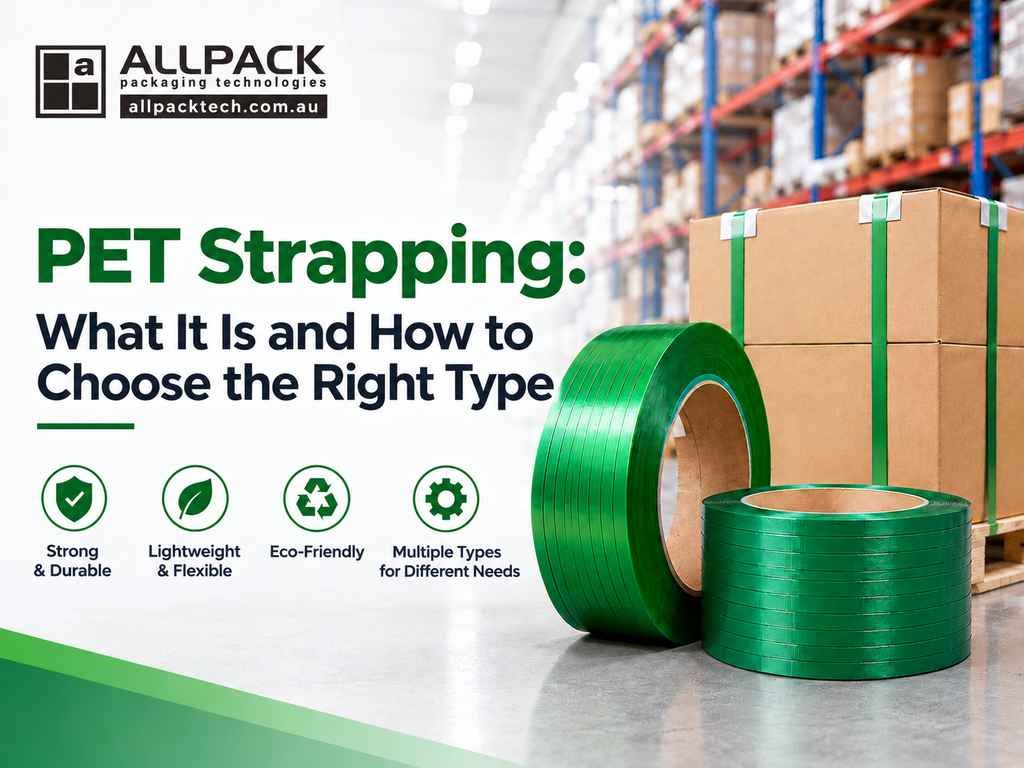
Pick up almost any pallet leaving a warehouse, and there’s a good chance it’s held together by PET strapping. It’s one of those products nobody thinks about until a load shifts or a strap snaps, and then it’s suddenly the only thing anyone’s talking about.
The good news is that choosing the right strap isn’t complicated once you know what to look at. Strength matters, but so do width, thickness, surface finish and whether the strap actually works with your tools. Here’s how it all fits together.
What Is PET Strapping and How Does It Work?
PET strapping is a polyester strap made from polyethylene terephthalate. You wrap it around a carton, bundle or pallet, pull it tight, and join the ends so everything stays put.
What makes it popular is how it behaves under load. It stretches a little and then recovers, so if a pallet settles after packing, the strap can take up some of that movement and keep holding. Steel doesn’t do that. PET also won’t rust, and it’s lighter to carry around. It still needs care when you’re tensioning and cutting it, because a strap under tension can whip back.
You’ll find it in different widths, thicknesses and finishes (smooth or embossed). The right combination depends on your goods and your equipment. If you want to see the full range side by side, the steel, PP and PET strapping range is a handy place to start.
Where Is PET Strapping Used?
Anywhere a package needs extra holding power during storage, handling or transport. The load’s shape and stability decide whether it’s a good fit.
Pallets, cartons and warehouse work
Warehouses and distribution centres use PET strapping to keep palletised cartons and grouped packages together. It stops individual items from working loose during routine handling.
How you apply it matters as much as the strap itself. A tall pallet or one with uneven weight may need extra restraint rather than simply more tension. Corner protectors help too, since they spread the pressure and stop the strap biting into cartons.
Timber and building materials
Timber packs, bricks, tiles and paper products are common candidates, as long as the strap’s strength and size suit the load. Heavy, sharp-edged or awkward materials need extra thought.
One thing worth remembering: a strap that holds a bundle together doesn’t make the whole load safe for the road. The National Heavy Vehicle Regulator’s load restraint guide explains how restraint has to account for the load, the vehicle and the forces involved in transport. If you’re unsure about your setup, get qualified advice.
How Strong Is PET Strapping?
Strong, but “strong” isn’t one number. Real-world performance depends on the strap’s dimensions, how it’s made and how it’s joined. These are the four terms worth knowing:
- Breaking strength: the force needed to snap the strap under test conditions. It’s not a safe working load.
- Joint strength: how well the sealed or welded join holds. A strong strap with a poor join will still fail.
- Tension retention: how well the strap keeps its grip as the load settles.
- Elongation and recovery: how much it stretches and how it bounces back.
Picture a pallet of cartons that sinks slightly after wrapping. A strap with the right give can absorb that and stay snug. But too much movement, badly placed straps or a weak join can still undo the whole thing.
So don’t choose on breaking strength alone. Look at the whole setup: the load, how many straps you’re using, where they sit and what your equipment is rated for.
Which PET Strapping Size Should You Choose?
It comes down to the load, the strength you need and what your tool or machine can handle. Before ordering, check these details:
| Specification | What to check | Why it matters |
| Width | Strap width in mm | Must suit the load and equipment |
| Thickness | Strap thickness in mm | Affects performance and tool compatibility |
| Roll length | Metres per roll | Affects roll changes and stock planning |
| Core size | Internal diameter of the roll | Must fit your dispenser or machine |
| Strength | Manufacturer’s stated performance | Shows if it suits the task |
As a real example, Allpack’s green smooth polyester PET strapping measures 16 mm wide by 0.9 mm thick, with 1,100 metres per roll and a 406 mm core. Those figures belong to that product only. They’re not standard for every PET strap.
Check any strap against your equipment manual before you buy. A wider strap isn’t automatically better, and two straps with the same width can have very different strength.
Smooth vs embossed PET strapping
Smooth strapping has a flat surface, while embossed strapping has a textured pattern. The finish changes how the strap feeds through machines, grips the load and welds.
Neither one wins every time. Smooth suits setups designed around that finish, and embossed works better where the texture helps grip or feeding. Let your equipment and your goods decide.
How Do You Choose PET Strapping Tools or a Machine?
Think about how often you pack, which strap sizes you use, and how the strap needs to be tensioned and joined.
Manual and battery-powered tools
For lower volumes or work that moves around, manual tools are often enough. You may need separate tools for tensioning, cutting and sealing, depending on the setup.
Battery-powered combination tools roll several of those steps into one, which helps if you’re strapping all day. Whatever you pick, confirm the strap width and thickness it’s approved for, plus its tensioning range and joining method. A tool made for one strap won’t necessarily suit another.
Operators should also be set up safely. Safe Work Australia’s guidance on hazardous manual tasks is a good reference for repetitive work like this.
Semi-automatic and automatic machines
Semi-automatic machines suit regular packing, where an operator positions the package and the machine does much of the strapping. Automatic systems make sense for high-volume, repetitive lines.
Volume isn’t the only factor. Strap size, core requirements, feeding, sealing method and package size all have to match the machine. Browse the strapping equipment range and confirm approved consumables before you switch straps. If you’re changing specs, a quick trial run can catch feeding or joining problems before they slow down production.
PET vs PP vs Steel Strapping
Each material behaves differently, so the right one depends on the job rather than price or weight alone.
| Feature | PET | PP | Steel |
| Common uses | Palletised goods and heavier bundles | Cartons, bundles and lighter tasks | Heavy-duty or rigid loads |
| Behaviour | Good tension retention, some stretch | Suited to lighter-duty work | Rigid, little stretch |
| Corrosion | Doesn’t rust | Doesn’t rust | Can corrode |
| Handling | Care when tensioning and cutting | Care when tensioning and cutting | Sharp edges and stored tension |
In short, PET works well when holding tension matters, PP covers plenty of lighter jobs, and steel still has a place in demanding applications. No material is always stronger, safer or cheaper, so compare actual products. The PET, PP and steel strapping options page makes that easier.
What to Check Before You Buy
Run through this quick list before ordering:
- Load: weight, shape and stability.
- Dimensions: the strap width and thickness approved for your use.
- Performance: whether the stated strength meets your needs.
- Finish: smooth or embossed, based on your goods and equipment.
- Joining method: whether your tool or machine can make a suitable joint.
- Roll fit: roll length and core size for your dispenser.
- Transport: whether the whole restraint arrangement meets the applicable requirements.
A few minutes here can save you from mismatched equipment, weak joints and costly changes later.
Choose PET Strapping With Allpack Packaging Technologies
Allpack Packaging Technologies supplies packaging consumables and equipment to Australian businesses. If you’re weighing up PET strapping, compare the specs against your load and your equipment first. When you’re ready to talk through your options, get in touch with the Allpack team or call 08 9244 1515.
Frequently Asked Questions
Is PET strapping suitable for outdoor storage?
It depends on the product’s UV resistance, how exposed it is and how long it’ll sit outside. Check the manufacturer’s specs before using any strap outdoors for an extended period.
Can PET strapping be recycled?
PET is a recyclable plastic, but whether used strapping is accepted depends on local facilities, its condition and contamination. The Australian Government’s Department of Climate Change, Energy, the Environment and Water is a good starting point for national waste and recycling information. Check what’s available to your business locally.
Does PET strapping need a special seal?
It depends on your tool or machine and the strap. PET can be joined with compatible friction-welding systems or suitable seals. Follow the manufacturer’s instructions.
How should I store PET strapping rolls?
Follow the supplier’s storage guidance. Keep rolls clean, protected from damage and away from conditions the manufacturer advises against. Store them securely so they can’t fall or unwind.