
What to Consider When Buying Strapping Equipment: A Complete Buying Guide
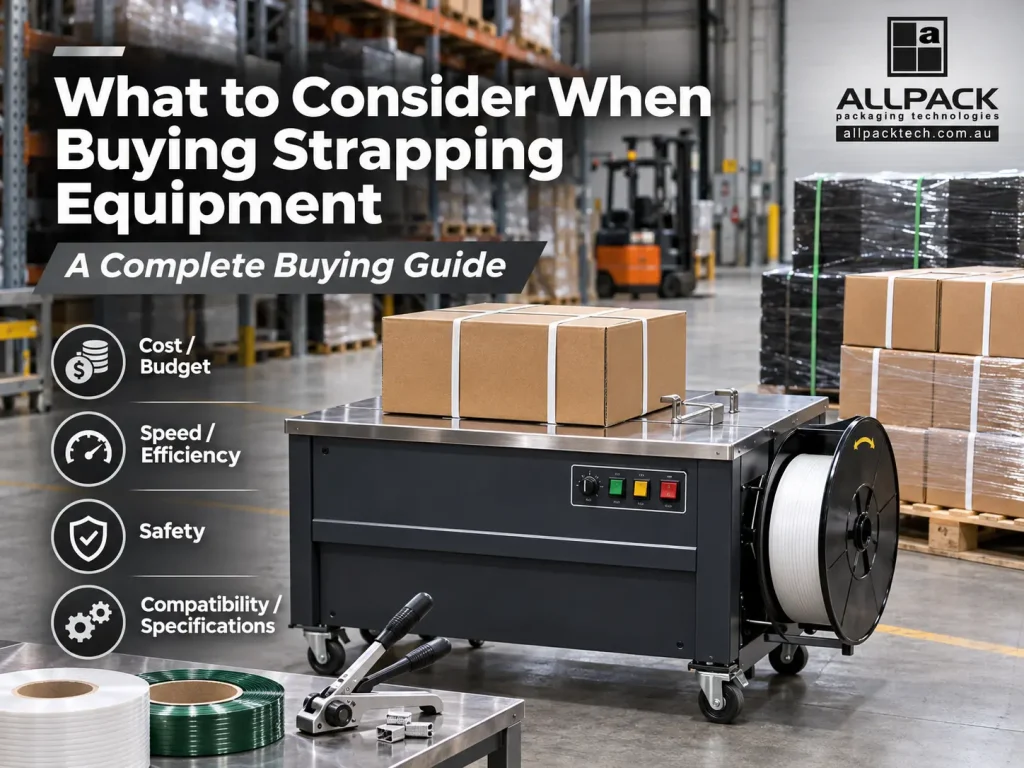
A loose strap at your loading dock can become a collapsed pallet halfway to Kalgoorlie. Most of those failures trace back to equipment that never suited the job in the first place.
The right choice depends on how many straps you apply each day, what you’re strapping, which strap material you use, and the space and power you have on site. As a rule of thumb, low volumes suit manual or battery hand tools, a steady flow of cartons suits a semi-automatic strapping machine, and a continuous production line suits an automatic arch machine.
We’ve been matching Australian businesses with packaging machinery for more than two decades from Osborne Park in Perth. In that time, we’ve seen businesses overspend on automation they didn’t need, while others wore out their staff with hand tools they outgrew years ago. The sections below will help you avoid both.
What Is Strapping Equipment and How Does It Work?
Strapping equipment is any tool or machine that wraps plastic or steel strap around a load, pulls it tight and joins the two ends. It keeps cartons, bundles and pallets stable through storage and transport.
Banding is a different process. It groups items with wider, softer material at much lower tension. If you’re deciding between the two, we compare them in banding machines vs. strapping machines.
Every strapping tool and machine follows the same four steps.
- Feed → the strap goes around the pack, either by hand or through an arch.
- Tension → the tool pulls the strap to the tension you’ve set.
- Seal → the ends are joined with a heat seal on PP tabletop and arch machines, a friction weld on battery tools, or metal seals and crimped joints on manual and steel tools.
- Cut → the strap is cut from the coil, ready for the next pack.
The joint is where most straps fail. When you compare equipment, ask how it seals the strap as well as how fast it runs.
Types of Strapping Machines and Tools
Most Australian warehouses, factories and yards use one of five options, and each suits a different workload.
Manual strapping tools
A manual tensioner and sealer, or a combination tool that does both, is the most affordable starting point. It needs no power, so it works anywhere from a timber yard to a remote site.
The catch is effort. Every strap is tensioned by hand, so results vary between operators. Repetitive tensioning is also a task worth assessing under Safe Work Australia’s model Code of Practice for hazardous manual tasks.
If your team straps more than a handful of pallets a day by hand, it’s time to look at powered equipment.
Battery strapping tools
A battery tool is an automatic strapping tool you can carry around the floor. One press of a button tensions, friction welds and cuts the strap. Most run PET strap, and many also accept PP.
With no cords or air hoses, battery strapping tools suit pallets spread across a dispatch area or yard. Before you commit, hold the tool for a minute to judge its weight and check that it takes your strap width. Keep a second battery on charge so a flat one never holds up a truck.
Semi-automatic strapping machines
A tabletop strapping machine handles a steady flow of cartons at one packing bench. The operator places the carton, passes the strap around it and pushes the end into the slot. The machine then tensions, heat seals and cuts.
Our Packway PW-616H is a good example. It runs 9, 12 or 15 mm PP strap, applies 15 to 50 kg of tension, finishes a strap in about 2 seconds and runs on single-phase power. Its table adjusts from 750 to 890 mm, so operators aren’t hunched over all shift. The PW-620H adds electronic strap tension for more consistent results across mixed carton sizes.
Automatic arch strapping machines
An automatic strapping machine feeds strap through an arch on its own, so the operator only positions the pack. On an integrated line, conveyors deliver each pack and the cycle starts without anyone touching it.
Our Packway PW-0860CAT also threads the strap automatically, which saves fiddly downtime at every coil change. Measure your largest pack before choosing an auto strapping machine, because the arch opening limits what you can strap. You’ll find our full range of semi-automatic and automatic strapping machines on our equipment page.
Pallet strapping machines
At the end of a busy production line, a fully automatic pallet strapping machine straps whole pallets without an operator. Our Packway PW-YAO is a side sealing model built for that job.
It needs more floor space and layout planning than any other option here. We explain where it pays off in our post on pallet strapping equipment.
| Equipment | Best for | Usual strap | Operator’s job | Watch out for |
| Manual tools | Occasional pallets, bundles, steel strap jobs | PP, PET, steel | Everything | Fatigue and uneven tension |
| Battery tools | Regular pallet strapping across a site | PET, PP | Positions tool, presses button | Battery life, tool weight |
| Semi-automatic | Steady carton flow at one bench | PP | Places pack, feeds strap | Operator still sets the pace |
| Automatic arch | Continuous carton lines | PP | Positions pack, or nothing with conveyors | Arch size, strap quality |
| Pallet strapping machine | High pallet output at end of line | Varies by model | Nothing once integrated | Floor space and layout |
Still weighing up hand tools against a machine? We cover the pros and cons of manual vs automatic strapping machines.
What to Consider When Buying Strapping Equipment: 7 Factors
Match the equipment to your daily volume first. Then check your loads, strap, space, power, support and lifetime cost, and the equipment will pay for itself.
1. How many you strap each day
Count straps rather than packs, because one pallet might take four straps and one carton might take two. Then plan for your busiest stretch, whether that’s the Christmas rush, harvest or end of financial year.
If you buy for an average week, the strapper becomes the bottleneck exactly when orders peak.
2. What you’re strapping
Cartons, bundles and pallets each place different demands on equipment.
- Small packs need a small minimum strapping size. The PW-616H handles packs as small as 60 mm.
- Soft or crushable goods need adjustable tension so the strap doesn’t dent the product.
- Heavy or sharp loads like timber, steel or bricks need stronger strap and edge protectors.
3. Strap material, width and thickness
Your strap and your equipment have to suit each other.
- PP (polypropylene) suits light to medium cartons and is the standard strap for heat seal machines.
- PET (polyester) holds tension on heavier loads in transit and is the usual choice for battery tools.
- Steel suits very heavy or sharp loads. It’s normally applied with dedicated manual or pneumatic steel tools rather than tabletop machines.
Our PP vs PET strapping comparison covers the differences in detail.
Bring a sample of your current strap when you see a machine run. That way, you can check its width, thickness and break strength against the machine’s specs.
4. Space, workflow and safety
Work out where the equipment will sit and how packs will reach it. A tabletop machine fits beside a packing bench, while an arch machine with conveyors needs a clear run of floor.
Keep the area around the machine uncluttered. Wear gloves and eye protection, because a tensioned strap can whip back when it’s cut. Always isolate power before clearing a jam.
5. Power supply and portability
Semi-automatic machines such as the PW-616H run on single-phase power. Larger automatic systems may need three-phase power, and pneumatic tools need compressed air.
Confirm your site’s supply with your electrician before delivery, so a new machine isn’t left sitting in its crate. If your strapping happens out in the yard, a battery tool removes the power question altogether.
6. Service, spare parts and strap supply
Every strapping machine has wear parts, such as the heater, cutter and feed rollers. Local stock decides whether a breakdown costs you an hour or a fortnight.
Your strap coils also need to fit the machine’s dispenser. The PW-616H, for example, offers 230 mm and 280 mm dispenser inner plates.
Before you buy strapping tools or machines, put these questions to your supplier.
- → Who services this equipment in Australia, and how quickly can they respond?
- → Which wear parts should we keep on the shelf?
- → Can you keep supplying strap that suits this machine?
We supply steel, PP and PET strap to match the equipment we sell.
7. Budget and total cost of ownership
The price tag is only the start. Strap is your ongoing cost, while labour, downtime and repairs quietly add up over the years.
Automation level, arch size, conveyors, strap type and servicing all push the investment up or down. Cheap strap with rough edges or heavy curl causes misfeeds and jams, so saving cents on consumables can cost you dollars in lost time.
Find the Right Strapping Equipment With All Pack Tech
At All Pack Tech, we help Australian manufacturers and distributors choose strapping equipment that fits the way they actually work.
Tell us your daily volume, your products and your strap, and we’ll recommend the tool or machine that suits. We’ll then back it with spare parts and the right consumables.
FAQs
Should I choose a battery or pneumatic strapping tool?
Battery tools suit most warehouse pallet strapping because they need no air lines and move freely. Pneumatic tools suit heavy, continuous work on sites already running compressed air.
How many straps can a battery strapping tool do per charge?
That depends on the tool, battery size, strap type and tension setting. Ask your supplier for figures from actual use, and keep a spare battery charged for full shifts.
Are cheap online strapping tools worth buying?
They can suit occasional use, but replacement parts and local servicing are often hard to find. For daily work, buy from a supplier who supports the tool in Australia.
Can a semi-automatic strapping machine run on a normal power point?
Many semi-automatic machines run on single-phase power, so a standard outlet often works. Check the machine’s current draw and plug rating with your supplier before ordering.
How long does a heat seal strapping machine take to warm up?
Most need a few minutes for the heater to reach sealing temperature. Strapping before then gives weak or failed joints, so switch the machine on before your first pack.
Is a used strapping machine a good idea?
A used machine can save money upfront if parts are still available. Check its service history, heater condition and Australian electrical compliance before you pay.
How often should a strapping machine be serviced?
Follow the manufacturer’s service schedule, and clean strap dust from the heater and feed path regularly. Busy lines usually need more frequent checks than machines used occasionally.